Alexandra Type Collapsible Needle Case, Early 20th Century Sewing Accessory
$0.00
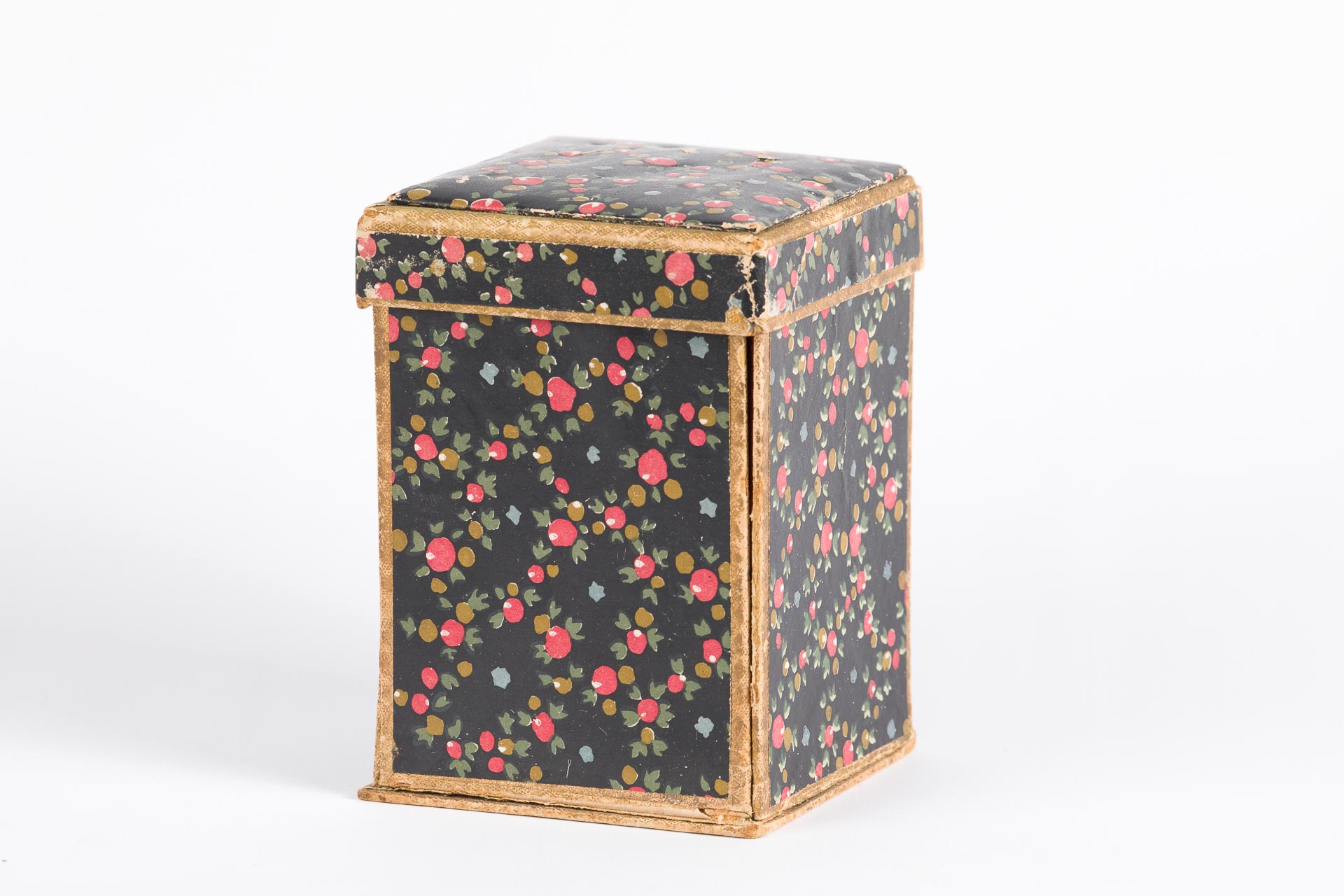
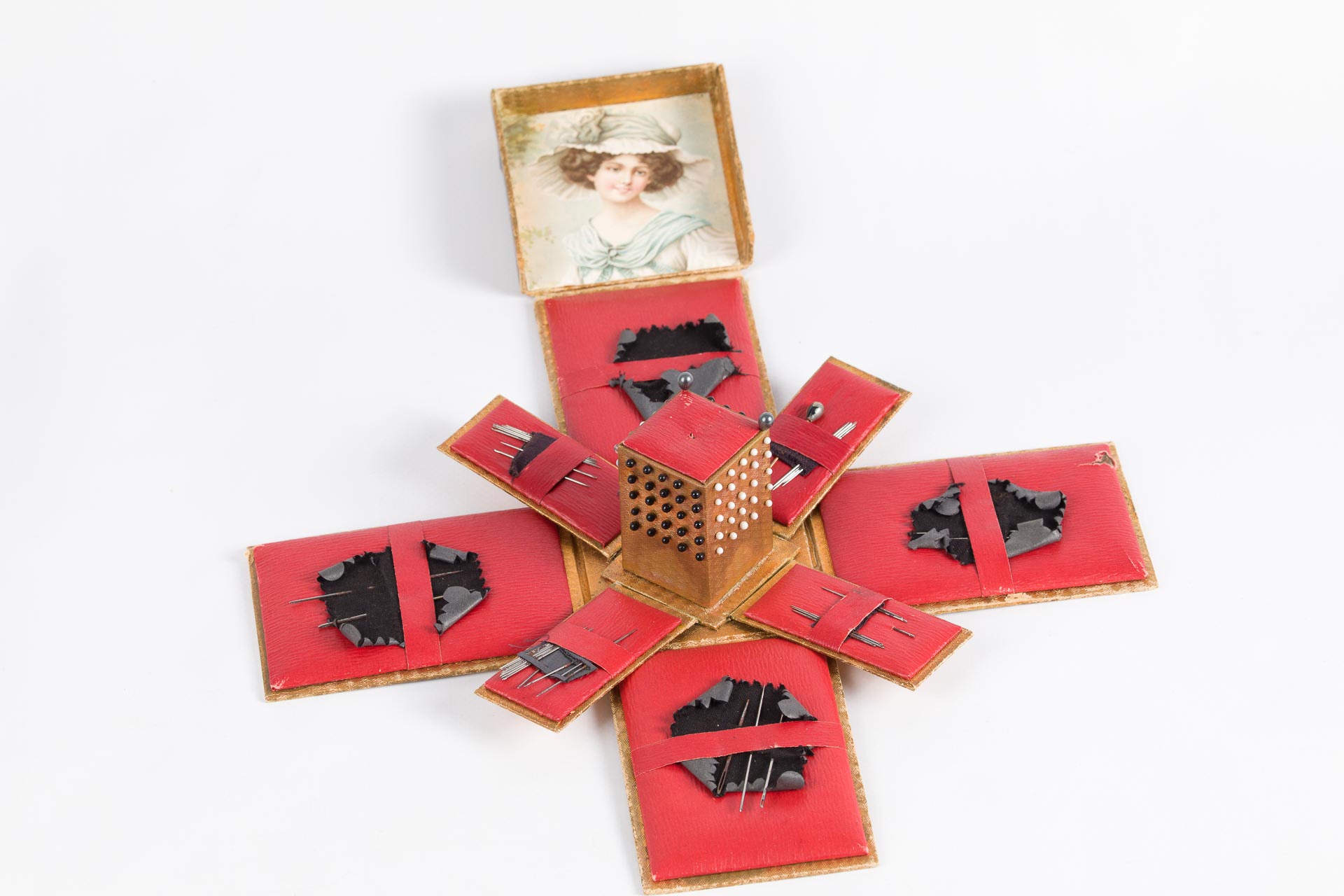
An early 20th-century Alexandra type collapsible needle case with floral paper covering, folding red-lined panels, portrait lid and central pin holder.
SOLD
This Alexandra type collapsible needle case dates from the early to mid-20th century, probably between the 1920s and 1940s. When closed, it takes the form of a small rectangular box covered in black paper printed with a close-set pattern of red, yellow and green flowers. Gold-coloured borders define the edges and frame each outer panel. Lifting the lid reveals a printed portrait of a woman on its underside. The case then opens further, with its outer walls folding flat and the smaller red-lined sections spreading out around a central, perforated pin compartment. Black retainers on the folding panels hold hand-sewing needles of different sizes. No maker’s name or manufacturing mark is visible in the supplied images, and its country of origin has not been established. Its design belongs to a recognised group of portable needle cases made for domestic sewing and personal needlework.
Condition Report
The needle case is in antique condition, with wear consistent with its age, materials and original use. The black floral paper covering displays rubbing, surface losses and wear along the corners, borders and folding edges. The gold-coloured trim has darkened and worn in places. Marks and discolouration are present on the red interior panels, particularly near the hinges and needle retainers. The portrait beneath the lid remains legible, with age-related fading, foxing and discolouration to the surrounding paper. The collapsible walls and inner leaves open to reveal the original compartmental arrangement, although the paper, card and connecting folds should be handled carefully. Several needles appear to remain in the black retainers. The central perforated section is present and shows expected oxidation and surface wear. No restoration or maker’s mark is evident from the supplied photographs.
Dimensions
Weight: 129gm, Length: 8cm, Width: 8cm, Height: 10.5cm.
A Compact Case for Needles and Pins
This case was intended to organise the small tools required for hand sewing. In its closed form, the upright box protected the contents and occupied little space on a dressing table, work table or sewing shelf. Once the lid was raised, the outer walls could be folded down and the smaller sections opened out, giving access to the needles arranged around the centre. The black retainers separated needles by size or purpose, while the perforated central compartment provided a place for pins. This expanding format allowed the user to view the contents at once rather than search through a conventional box. The portrait inside the lid added a decorative feature to an otherwise practical household object.
Early Twentieth-Century Decorative Utility Design
The case combines a geometric opening mechanism with ornament drawn from established floral and portrait traditions. Its date overlaps with the Art Deco period, and the compact rectangular form, strong borders and radial interior arrangement reflect the period’s interest in ordered, functional design. The surface decoration, however, is not characteristically Art Deco in a strict sense. The small flowers scattered across a black ground relate more closely to chintz-patterned papers used on domestic boxes, stationery and sewing accessories during the late 19th and early 20th centuries. Inside, the red paper creates a clear contrast with the black needle retainers and gold-coloured centre. The female portrait beneath the lid follows the long-standing practice of decorating personal cases with printed images. These elements place the object between traditional Victorian sewing accessories and more compact forms developed during the interwar years.
Paper-Covered Card and Collapsible Construction
The case was probably constructed from shaped card panels joined with paper or textile hinges. The exterior panels were covered individually with printed floral paper, after which narrow gold-coloured strips were applied around the edges to conceal joins and reinforce the box-like outline. The interior was lined with red paper before the needle retainers were attached. These black retainers may be formed from folded paper, card or textile and were positioned to secure groups of needles without requiring separate packets. The multiple hinged walls had to be measured so that they could fold inward in sequence and fit beneath the lid. At the centre is a gold-coloured perforated receptacle intended for pins. The applied portrait was mounted inside the lid as a final decorative element. Such construction relied on accurate cutting, folding and pasting rather than cabinetmaking, allowing a complex case to be produced from relatively light materials.
An Unidentified Maker of Sewing Accessories
No manufacturer’s label, printed trade name or stamped mark can be identified in the photographs, so the case cannot be assigned securely to a particular workshop or country. The term “Alexandra type” describes the recognised format rather than establishing an individual maker. Needle cases of this general class were produced by stationers, box makers and manufacturers of sewing accessories, often using commercially printed papers and standard steel needles. Production may have involved several trades: card cutters formed the structural panels, paper workers covered and lined the case, and an assembler fitted the retainers, central pin section and portrait. The absence of a maker’s mark is not unusual for small domestic accessories, which were frequently sold through drapers, haberdashers and department stores under a retailer’s name or without branding. Attribution should therefore remain limited to the early to mid-20th-century date indicated by its materials, construction and decorative treatment.
Collected as Sewing and Social-History Material
Needle cases are collected as examples of sewing equipment, paper-covered boxes and domestic material culture. Their formats range from simple wooden cylinders and metal packets to folding books, fitted cases and novelty forms. Collapsible examples are of particular interest because their structure records how manufacturers approached storage and display within a small object. Collectors also examine surviving labels, needle arrangements, printed decoration and internal fittings, as these details can assist with dating and attribution. Cases retaining their original interior components provide evidence of how needles and pins were sorted before modern plastic organisers became common. Portraits and patterned papers also connect these objects with the history of commercial printing and changing domestic taste. This example’s transformation from an upright floral box into a radial sewing case makes it relevant to collections concerned with needlework, haberdashery, ephemera, packaging and early 20th-century household design.